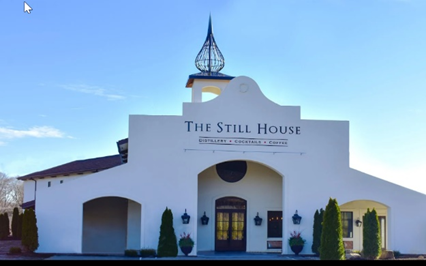
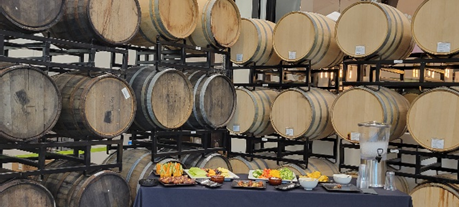
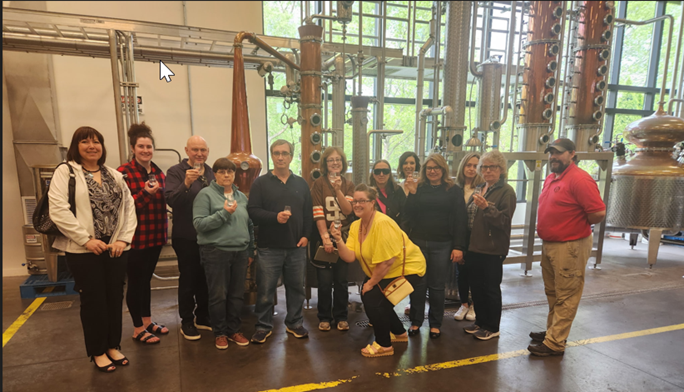
 Twenty-three folks came out to The Still House at Gervasi Vineyard on Sunday, May 25. There were tasty hors d’oeuvres and networking to start. Then, Michael, the Assistant Distiller took us on an interesting journey for the next hour into the amazing world of distilling. The Still House is an interesting building that was patterned after the Church of St. Gervasio in Genoa, Italy. The Still House just came to be in 2019. Long, long before that, there was a sawmill by the pond, then a cattle farm, then a tree farm.
Why is bourbon called “bourbon”? Nobody really knows, but there was an “Old Bourbon” port on the Ohio River. After the Revolution, this port of origin stamped its name on barrels of bourbon. In 1963, Congress defined what can be called “bourbon”. First, it must be made in America. At least 51% of the mash must be corn, (Gervasi uses 70% corn in its mash), 20% rye, and 10% barley. Bourbon barrels must be charred on the inside. New barrels must be used each time, and the barrels must be made of American white oak.
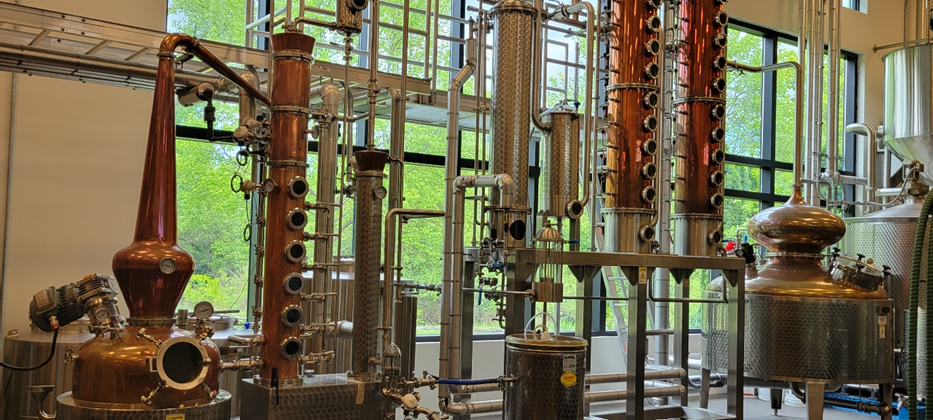
The still was beautiful, made of copper. Copper is used in stills because it removes impurities. Bourbon runs two times through the still. The process for the mash is a step-down in temperature affair with the highest temperature for the corn, then a step down in temperature for the rye, and yet another step down in temperature for the yeast. The mash ferments for three days. Vodka and gin also go through the still at Gervasi. The law states that the bourbon must be lower than 125 proof. Most of the bourbon is 80 proof.
Gervasi sources its grains locally. The rye comes from Wooster, the barley from Hartville, and the corn from around six miles away from the vineyard. Feed corn is used.
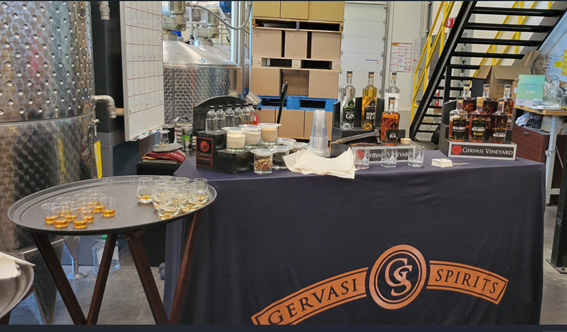
The bourbon tasting consisted of four samples:
- Straight Bourbon Whiskey. (I won’t lie. This one hurt a little going down).
- Wine Barreled Bourbon. The bourbon ages around 4 years in its original barrel, then gets put in a wine barrel that has been used three times for two more years. The tannins from the wine are pulled into the barrel to make a different taste.
- Rum Barreled Bourbon. Same as above, except the final two years is in a barrel used originally for Caribbean rum.
- Maple Syrup Barreled Bourbon. Same as above, except the final two years is in a barrel that was used originally for maple syrup. This final sample was in a Gervasi signature shot glass that we were able to take as a souvenir.
Some other interesting facts about distilled products… White whiskey is not aged. That’s why it has no color. Scotch doesn’t use new barrels.
Everyone had a good time and learned a lot.
1)